A B&B and small hotel website often has one big goal: more guests who book directly with you instead of through a booking platform. Platforms bring reach, but take commission on every booking. So every guest who books directly earns you more. To make that happen, your own site needs to work just as easily as a platform, and give guests a reason to book direct.
In this article you will read what a B&B or small hotel site needs, how online booking and payments work, how to avoid double bookings and how to get found. It works for a B&B with two rooms and for a hotel with a few dozen rooms.
What should a B&B or small hotel website include?
- A homepage that shows the atmosphere and the location in a single image.
- A page per room, with photos, size, beds, facilities and price.
- An availability calendar and a button to book directly.
- Information on breakfast, check-in, check-out, pets and parking.
- The surroundings: what is there to do, and how far is the beach, the town centre or the station?
- Guest reviews.
- Your cancellation policy, clear and easy to find.
- Contact details and directions.
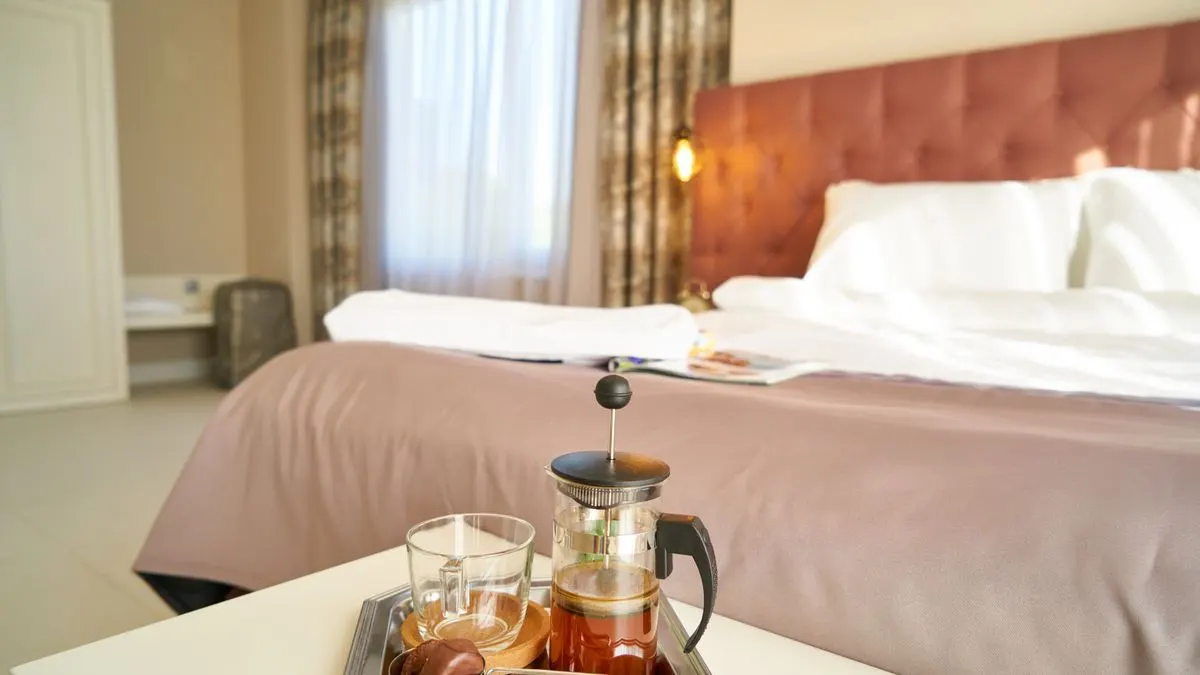
Guests choose mainly on photos. Show every room as it really is, in daylight, including the bathroom and the view. Disappointment on arrival leads to bad reviews, and those carry a lot of weight.
Why direct bookings matter so much
Booking platforms are useful for being found. Many guests discover you there first. But afterwards they often search for your name in Google to look at your own site. If they can book easily there, many people prefer to book direct.
That doesn't mean you have to drop the platforms. For most B&Bs and small hotels they actually work well alongside your own site. The platform makes sure new guests find you. Your own site makes sure as many of them as possible, and certainly returning guests, book directly next time.
Give them a reason to do so:
- A small extra for booking direct, such as a welcome drink or a free late check-out.
- More flexible cancellation terms than through a platform. Do check what you have agreed with platforms about pricing.
- Personal contact: an email from you instead of a standard message.
- A booking process of just a few steps, with no account required.
You can reach returning guests directly too. With their permission, you can later send them an email with a seasonal offer. Read about this in our article on email marketing.
Online booking and payments on your own site
A contact form saying 'I'd like a room from 3 to 5 May' is not enough. Guests want to see straight away whether there is space and what it costs. A good booking engine does that. It is a piece of software on your website where guests choose their own dates, room and number of people.
- Live availability per room and per night.
- Automatic price calculation, including tourist tax and any extras such as breakfast.
- Secure online payment, or a deposit in advance.
- An instant confirmation email with all the details.
- A reminder a few days before arrival, with directions and check-in times.
Read how online payments work technically in our article on integrating online payments. And to find out when a custom booking system makes sense, read more about an online booking system.
Avoiding double bookings with an integration
If you rent out rooms through your own site and through one or more platforms, you don't want the same room booked twice. There are two solutions.
- A channel manager: software that automatically keeps your availability in sync across all channels. Your booking engine and the platforms then talk to each other through that tool.
- A calendar sync: simpler, with calendars updating each other at regular intervals. That works for small B&Bs, but there is sometimes a delay.
Which solution fits depends on the number of rooms and channels. A B&B with two rooms can often manage with a simple sync. A small hotel with several channels usually needs a channel manager. The costs of these tools vary widely, so compare current prices. Always test an integration with a few trial bookings before putting it live.
Getting your B&B or hotel found in Google
People search for 'B&B' or 'hotel' plus a town or region, or for something specific such as 'dog-friendly B&B by the sea'. Make sure your site answers those questions.
- Complete your Google Business Profile, with photos of the rooms, breakfast and surroundings.
- Ask guests for a review after their stay and respond to every review.
- Write a page about the area with tips you really give your guests.
- Mention the facilities people filter on, such as parking, pets, EV charging or wheelchair access.
- If you have many guests from abroad, consider your site in English and German.
Read more about a site in several languages in our article on a multilingual website.
Mistakes that make guests give up
- Only an email address for bookings, with no availability or price.
- Photos that look better than reality, or that are dark and blurry.
- A price that turns out higher at the last step because of extra costs.
- Cancellation terms that are nowhere to be found.
- A booking engine that doesn't work well on a phone, while many guests book on the go.
- No English version, even though a large share of your guests come from abroad.
Go through the whole booking process on your phone yourself, as if you were a guest. You will soon see where it gets stuck. Also ask a friend or family member to try it, and notice where they hesitate.
A website with a booking system from Violexa
At Violexa a website or custom web application starts from €1,799 excl. VAT (€2,177 incl. VAT) per project. That includes design, build, a design that works on every screen, basic SEO, Google Analytics, a CMS and training. A booking engine with payments or an integration with your channel manager comes with a fixed price upfront, in writing. We work from Amsterdam for businesses all over the Netherlands.
Want to know what your B&B or hotel needs? Request a free quickscan. In 30 minutes, online or on location, we look at your situation together. Afterwards you get short written advice with a price indication, with no obligation.
Frequently asked questions
How much does a website for a B&B or small hotel cost?
At Violexa a custom website starts from €1,799 excl. VAT (€2,177 incl. VAT). A booking engine with online payments or an integration with a channel manager costs extra. You get a fixed price for that upfront.
How do I get more direct bookings for my B&B?
Make booking on your own site as easy as on a platform and give a reason to book direct, such as a small extra. Also build a strong Google Business Profile and reviews, so guests find your own site.
How do I avoid double bookings between Booking.com and my own site?
With a channel manager or a calendar sync. These keep availability the same across all channels. With several rooms and channels, a channel manager is usually more reliable.
Should I mention tourist tax on my website?
It is clearer for guests if you show whether tourist tax is included in the price or charged separately. The rules and rates differ per municipality. If in doubt, ask your municipality or an adviser.